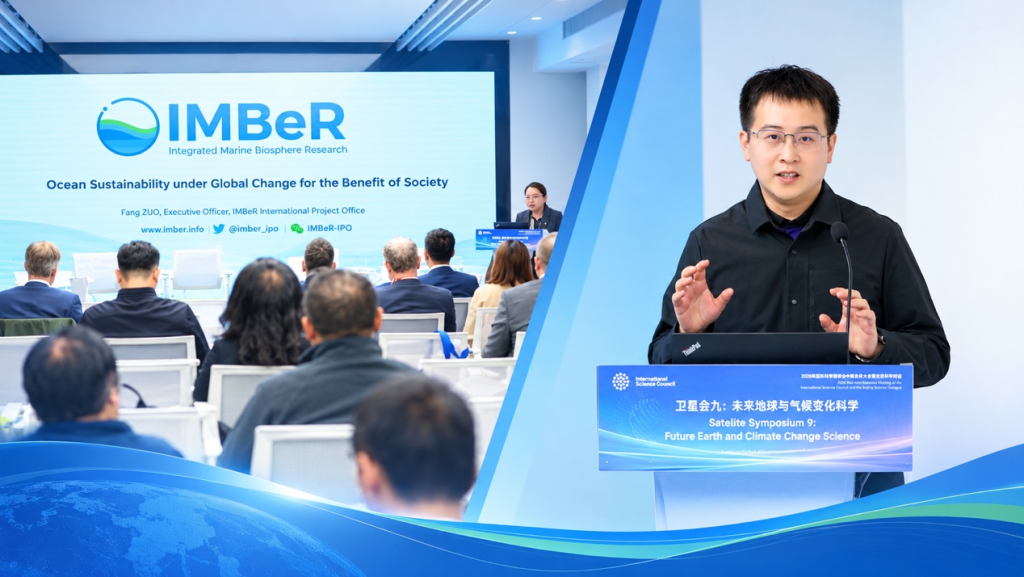
Advancing Global Ocean and Climate Governance
On 20 October 2026, the satellite symposium “Future Earth and Climate Change Science” was held at Tsinghua University in Beijing as part of the 2026 International Science Council (ISC) Midterm Members’ Meeting and Beijing Science Dialogue. As a Global Research Network of Future Earth with its International Project Office (IPO) based in China, IMBeR was invited to participate. ZUO Fang, IPO Executive Officer, and LIAN Peng, Co-Chair of the IMBeR-CLIOTOP Task Team, delivered presentations at the Young Scientists Forum, contributing to scientific dialogue on global climate governance.
The symposium was an important satellite event of the 2026 ISC Midterm Members’ Meeting and Beijing Science Dialogue, held under the theme “Science in a Complex World — Science for a Better Future.” It was jointly organised by nine institutions, including the International Science Council, the Future Earth Global Secretariat Hub (China), and the Southern Marine Science and Engineering Guangdong Laboratory (Zhuhai). Bringing together representatives of leading international scientific organisations and research institutions, including the World Climate Research Programme (WCRP) and the International Union of Geodesy and Geophysics (IUGG), the symposium featured keynote speeches, thematic discussions on developments within Future Earth, IUGG and IPCC, a Young Scientists Forum, and Round-table Discussions. Participants explored key issues including Earth system risks, regional adaptation to climate change, and international research collaboration, making the event an important platform for exchange in global climate and Earth system science.

At the Young Scientists Forum, ZUO Fang presented “Ocean Sustainability under Global Change for the Benefit of Society”. Drawing on research from the IMBeR global network, her presentation examined the multiple pressures that climate change places on marine ecosystems and highlighted the societal value of ocean sustainability and pathways towards achieving it. She also reflected on what global research networks can offer the next generation and how young scientists can collaborate to develop sustainable solutions to complex challenges.

LIAN Peng presented “Hybrid Modelling of Three-Dimensional Thermal Habitat Optima for Global Tuna Species”, sharing advances in modelling the thermal habitats of marine species and technical approaches underpinning this research. His work provides scientific insights to support the effective management and sustainable utilisation of pelagic fishery resources under climate change.

Together, the two presentations offered complementary perspectives, linking the societal dimensions of ocean sustainability with technical approaches to understanding marine species’ responses to a changing climate.
During the symposium, IMBeR representatives also exchanged views with experts working in integrated risk governance, coastal research, and the water–energy–food nexus. They participated in a round-table convened by the Earth Commission, discussing interdisciplinary research collaboration, the translation of research findings into awareness and action, and early-career researcher development.
Participants emphasised that addressing global climate change requires overcoming disciplinary and geographical boundaries, strengthening international scientific collaboration and data sharing, and translating scientific knowledge into tangible climate action and more effective governance. These priorities resonate with IMBeR’s commitment to advancing interdisciplinary and transdisciplinary marine research and strengthening the connections between ocean science, sustainability and society.
