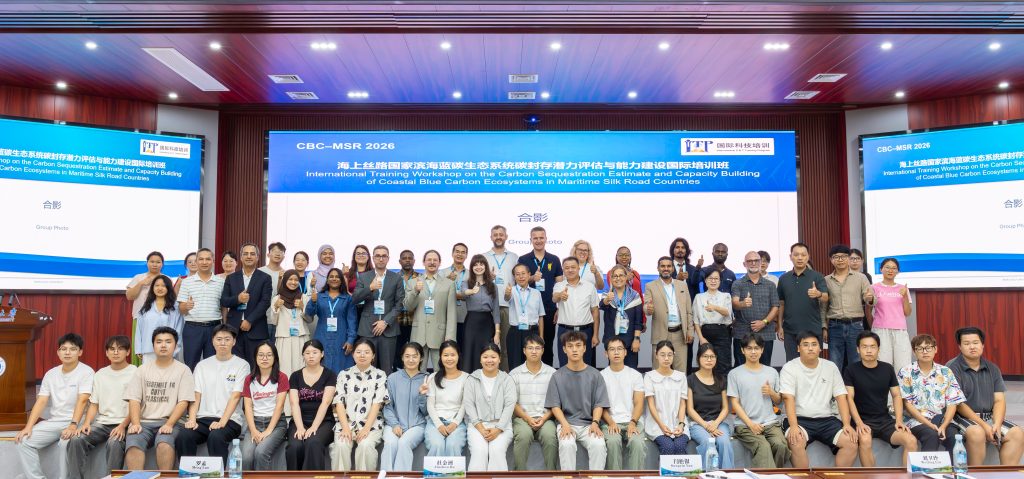
The Second International Training Workshop on the Carbon Sequestration Estimate and Capacity Building of Coastal Blue Carbon Ecosystems in Maritime Silk Road Countries (CBC-MSR 2026) was held from 18 October to 1 November 2026 in Shanghai and Qinzhou, Guangxi, China. Led by Jinzhou Du, a researcher at the State Key Laboratory of Estuarine and Coastal Research (SKLEC), East China Normal University (ECNU), the 15-day workshop brought together 20 researchers and government officials from 17 universities, research institutions and government agencies in 13 Maritime Silk Road and Belt and Road partner countries, including Croatia, Mauritius and Uruguay. The programme combined lectures, practical field training and opportunities for international academic exchange.
Following the inaugural workshop, held at ECNU in September 2024 with 27 participants from 13 countries, CBC-MSR 2026 was organized under the Technical Training Programme for Developing Countries of China’s Ministry of Science and Technology. It was sponsored and guided by the Department of International Cooperation of the Ministry of Science and Technology of the People’s Republic of China and the Science and Technology Commission of Shanghai Municipality. The workshop was jointly organized by SKLEC, Beibu Gulf University, the Guangxi Key Laboratory of Marine Environmental Disaster Processes and Ecological Protection Technology, and the Integrated Marine Biosphere Research (IMBeR) International Project Office.
The workshop officially opened on 19 October at ECNU’s Putuo Campus. It was endorsed as an official UN Ocean Decade Activity. The programme comprised two phases, in Shanghai and Qinzhou, Guangxi. With a focus on coastal blue carbon assessment, conservation and restoration, it combined classroom sessions, field sampling and international academic exchange. The training was designed to strengthen participants’ practical skills in field experiments, data collection, data processing and modelling, and to introduce low-cost, adaptable technologies for blue carbon monitoring. It also aimed to support the development of standardized carbon accounting and blue carbon trading systems.
Shanghai: Building Scientific Foundations and Connecting with International Research
The Shanghai phase coincided with the 5th UN Ocean Decade Conference on Mega Deltas and the UN International Decade of Sciences Conference on Coastal Sustainability. Participants attended thematic sessions and forums, where they learned about recent scientific advances and international research priorities in coastal and delta sustainability.
On 22 October, ECNU’s Putuo Campus hosted a series of lectures introducing coastal blue carbon ecosystems and carbon stock accounting. Fang Cao, Xiuzhen Li and Zhijun Dai spoke on topics including carbon exchange between coastal wetlands and adjacent waters; the carbon sequestration capacity of coastal marine ecosystems and its links with other ecosystem functions; and approaches to mangrove establishment and ecological restoration in estuarine wetlands. The lectures gave participants a broad overview of coastal blue carbon processes, ecosystem functions and restoration practices.


Outside the classroom, participants visited Jinshan Yingwuzhou Wetland in Shanghai, where Professor Xuechu Chen led a field-based teaching session. They also visited SKLEC to learn about methods for measuring and assessing carbon stocks in coastal blue carbon ecosystems.
The programme also included visits to the Shanghai Environment and Energy Exchange, where participants learned how carbon markets operate, as well as to Yangshan Deep-Water Port and the China Maritime Museum. These visits helped participants explore the links between blue carbon science, carbon trading and the maritime economy.


Guangxi: Practical Training in Mangrove Ecosystems
After the Shanghai programme, the workshop continued in Guangxi, with a focus on mangrove carbon processes, carbon fluxes and field-based assessment methods.
At the Maowei Sea Mangrove Nature Reserve, participants collected soil samples from mangrove wetlands for carbon stock assessment, putting the field methods introduced during the workshop into practice.
Participants also visited the Qinzhou Kongquewan Ecological Restoration Area, Fengjiajiang Ecological Restoration Wetland in Beihai, Beihai National Coastal Wetland Park, and the Madao Hub and Canal Ecological Restoration Area of the Pinglu Canal. These visits provided opportunities to observe and compare different approaches to coastal ecosystem conservation and restoration.
Visits to the Hepu Han Dynasty Culture Museum, which showcases the history of the Maritime Silk Road, and to the Pinglu Canal project also introduced participants to China’s long history of maritime exchange and its current efforts to advance ecological conservation alongside regional development.


Learning Outcomes and Future Collaboration
Towards the end of the workshop, participants worked in groups to discuss blue carbon accounting models and develop policy recommendations relevant to their respective countries. Each group prepared a report and presented its findings, applying the knowledge and techniques gained during the workshop to practical issues in blue carbon assessment and coastal management.
Participants highlighted the value of combining classroom instruction with hands-on fieldwork and site visits. They said the workshop had strengthened their technical understanding of coastal blue carbon assessment and provided valuable opportunities to connect and exchange ideas with researchers and practitioners from other countries. These new connections offer a basis for future cooperation in blue carbon monitoring, collaborative research and academic exchange.


The closing ceremony took place in Qinzhou on 30 October. Songyin Yan, Vice President of Beibu Gulf University, and Jinzhou Du of SKLEC, joined by invited guests, presented the participants with certificates issued by the Ministry of Science and Technology of the People’s Republic of China upon completion of the training programme.

During the workshop, several participants expressed interest in continuing to work with the organizing institutions, particularly on the application of blue carbon technologies, collaborative research and personnel exchanges.
SKLEC and the IMBeR International Project Office reaffirmed their commitment to building on the partnerships established through the workshop. They will seek to strengthen collaboration with Maritime Silk Road countries through international blue carbon cooperation platforms, with a focus on blue carbon monitoring and assessment, ecosystem restoration and capacity building.
The workshop has helped lay the groundwork for continued cooperation in coastal blue carbon assessment, ecological restoration and capacity building, contributing to efforts to conserve coastal ecosystems and address climate change.
Acknowledgements
The workshop was supported by the following programmes, institutions and initiatives: the Mega-Delta Programme under the United Nations Decade of Ocean Science for Sustainable Development (the UN Ocean Decade); Connecting Rivers & Oceans for Sustainable Solutions in the Coastal Zone (CROSS Coastz), an endorsed programme of the United Nations International Decade of Sciences for Sustainable Development (2024–2033); the Future Earth Coasts (FEC) International Project Office; the China–EU Intergovernmental Cooperation in Science, Technology and Innovation Special Project under the National Key R&D Programme of China (C-BLUEs and BLUE Seas); the Key Special Project of Intergovernmental International Scientific and Technological Innovation Cooperation under the National Key R&D Programme of China (Mechanisms of Erosion and Retreat in Estuarine Tidal Wetlands Driven by Climatic and Non-Climatic Factors and Restoration Technologies); the Shanghai Environment and Energy Exchange; the School of Law, East China Normal University; the Institute of Eco-Chongming, East China Normal University; Guangxi High-Level Discipline (Marine Science); the Pinglu Canal and Beibu Gulf Coastal Ecosystem Observation and Research Station of Guangxi; the Marine Science Top-notch Student Training Base, Beibu Gulf University; the Guangxi Beibu Gulf Marine Science and Technology Innovation Cooperation Base; and Beihai National Coastal Wetland Park.