
Ocean sustainability requires an Action Plan to address ocean change
The oceans are changing, affecting human communities across the world. Reducing greenhouse gas emissions to limit future warming is an immediate priority but we also know that decarbonisation will not be sufficiently rapid to limit warming to less than 1.5C. No matter what we do now, further major and potentially rapid changes to ocean ecosystems are inevitable over the coming decades. Planning and preparing now for those changes is a priority.
The United Nations Ocean Conference in Lisbon, Portugal in June 2025 demonstrated a high-level of international political and public recognition of the threats to the ocean. The need for action to address these threats has also been emphasized, as has the crucial importance of improving understanding of the ocean.
An extensive range of important international activities studying the ocean have been initiated under the UN Decade of Ocean Science for Sustainable Development. There are several excellent science projects analysing the impacts of change and programs developing potential policy responses. A systematic approach is also required to develop and coordinate activity from local to global scales.
Developing an Action Plan for the Ocean
Recent years have seen the generation of extensive international assessments of ocean change and future risks. IMBeR Scientists have proposed the development of an Action Plan for the Ocean to respond to these changes and risks.
This will involve a risk-based approach with three major components:
(1) assess and rank risks,
(2) identify options for action, and
(3) develop action plans for adaptation at local, regional and global scales to respond to future change.
The challenge:
- Existing efforts to restore marine ecosystems need to include the potential impacts of future change.
- Scientific advice is needed to help policy makers plan for change.
- Policy makers need clear presentations of the potential changes and associated uncertainties and policy options.
- Risk-based planning encompassing local, regional and global is required
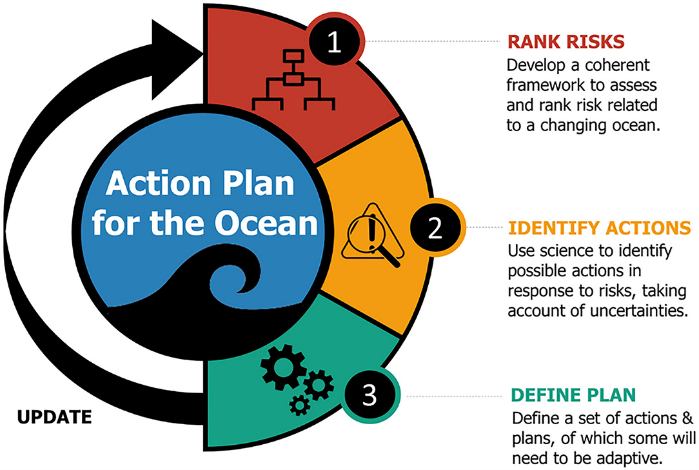
This process needs to be continuously updated as new information becomes available and understanding improves. Development of the Action Plan will also require engagement with those encompassing the full range of interests and perspectives on the ocean at local, regional and global scales.
The Integrated Marine Biosphere Research Programme (IMBeR) is now coordinating activity around this Action Plan and invites partnership and participation in the next steps.
We are assembling an integrated interdisciplinary ocean community to develop and implement the Action Plan for the Ocean, The Ocean100+. This diverse team of representatives from over 100 countries, will seek to:
- Develop international capacity in integrated analyses and risk-based assessment of ocean threats and actions.
- Build on current activities and develop partnerships drawing on expertise and inputs from established programmes and bodies.
- Provide a forum for the global ocean community to engage in the development of an Action Plan
Ocean100+ is open, collaborative, and growing. We welcome participation from scientists, policymakers, community leaders, NGOs, industry partners, and early-career professionals who want to contribute to building a more resilient and sustainable ocean future. Nominate yourself, or a colleague.
Contact Us
- actionplanfortheocean@gmail.com
A UN Ocean Decade Project
The Action Plan initiative is endorsed by the Sustainable Ocean Planning (SOP) Project, through the UN Ocean Decade.
