
Joel Llopiz was a long-time IMBeR and CLIOTOP member, contributing as a researcher, Early life history working group lead (2008-2015), and former CLIOTOP co-chair (2018-2021).
In January 2026, Joel Llopiz passed away from glioblastoma – an aggressive form of brain cancer. At 48 years, this is unfair in so many ways that trivialise this science obituary Joel K. Llopiz | Falmouth Obituaries. While we mourn Joel, we want to share and celebrate some of his contribution to scientific discovery and to friendship in our community.
Joel joined the CLIOTOP community when he attended and present a poster on his PhD research at the 1st CLIOTOP symposium, in 2007 held in La Paz Mexico. He was awarded his PhD in 2008 by the University of Miami in Florida, with a dissertation titled “The trophic ecologies of larval billfishes, tunas, and coral reef fishes in the Straits of Florida: Piscivory, selectivity, and niche separation”, supervised by Dr Bob Cowen. After a couple of post-docs at Miami and then the Woods Hole Oceanographic Institution (WHOI), Joel joined the WHOI as an assistant scientist in 2012, where he remained for the rest of his career as he progressed through academic ranks.
Joel’s early research involved the first ever examination of the diets and feeding success of Atlantic bluefin tuna larvae in the Gulf of Mexico, which showed bluefin larvae have a notably high degree of feeding success, a high reliance on appendicularians, and a relatively early onset of piscivory (consuming other fish larvae), including the frequent occurrence of cannibalism (Llopiz et al., 2015).
He shared his passion for things larval with graduate students and classes at WHOI, and diversified research activities in the lab and on research vessels to study impacts on other marine species in north-east USA, including eel, sand lance and forage fishes such as Atlantic herring, alewife, blueback herring, Atlantic mackerel, and Atlantic butterfish. Joel’s research team used both traditional gut content analysis coupled with stable isotopes to find surprising inter-specific distinctions in diets, given that these planktivorous species exhibit substantial spatial overlap. They also revealed marked spatial and temporal variability within species (Suca et al., 2018). Joel also joined and led research abroad several Arctic research voyages, an area he was excited to visit and understand.
In his own words, written in 2022 for a very formal process, his introduction to his research summary shows his personality and passion:
“I often struggle to describe the integrative nature of my research without a bit of further explanation. When meeting new colleagues, I probably say most frequently “I’m a fish and zooplankton ecologist,” but I’m never fully satisfied with this answer. “Fisheries oceanographer” is most accurate, since it is a formal term for those who study how fish ecology, behavior, and distributions are influenced by the physical and biological environment—which is exactly what we do in my lab. But this term is confusing to many since we do not work on fisheries per se. Other somewhat suitable terms could include biological oceanographer, forage fish ecologist, or larval fish ecologist. (“Fishy oceanographer” would be close to perfect, but I doubt this will catch on.) None of these descriptions, however, fully capture what I enjoy most about science: collaboration and education. Both of these facets of my work keep me motivated and invigorated.”
Joel also continued his involvement in IMBeR and CLIOTOP, attending IMBeR-wide Open Science meetings, IMBIZO events, and CLIOTOP symposia from Bergen to Brest and beyond. He would arrive at these meetings with back-streets restaurant suggestions, and we’d wander those streets looking for these places, all before mobile phones made it easy. He was a fan of shared houses when we attended international meetings, and those experiences were so much more fun than staying in a hotel and riding an elevator to the meeting floor. Of course, each time we travel for work, we leave behind family and commitments, but these face-to-face experiences make our professional lives so much richer, and I thank Joel’s family for sharing him in this parallel life with us over all those times. While our photos may be of stiff meeting attendees, and we worked hard through agendas and to share research, the time spent with Joel led to his many enduring friendships in our community.
Joel was a natural teacher and leader, generous with his time and knowledge, and deeply invested in the growth of others. He led not through authority, but through curiosity, kindness, and example, encouraging early-career scientists and peers alike to think broadly and trust their scientific instincts. Many in our community benefited from his quiet guidance and steady encouragement. His legacy lives on not only in his science, but in the confidence, collaborations, and careers he helped to shape.
Across his career, Joel was a valued member of many research efforts – he brought unique skills, appreciation of observational data, and no ego. We will continue to share the values that Joel espoused and we miss his warmth and generosity.
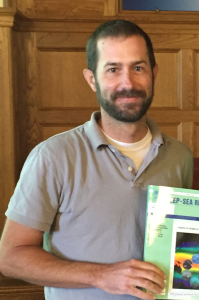
3rd CLIOTOP Symposium, San Sebastián, 2015
Selected citations
Llopiz, J. K., B. A. Muhling, and J.T. Lamkin (2015). Feeding dynamics of Atlantic bluefin tuna (Thunnus thynnus) larvae in the Gulf of Mexico. ICCAT Collective volume of scientific papers, 71(4), 1710-1715.
Suca, J. J., J. W. Pringle, Z. R. Knorek, S. L. Hamilton, D. E. Richardson, and J. K. Llopiz (2018). Feeding dynamics of Northwest Atlantic small pelagic fishes. Progress in Oceanography,165, 52-62.